Skip to content

Key takeaways
- A digital landline carries calls over broadband instead of copper. The UK’s analogue network closes on 31 January 2027.
- Phones are the easy part. Alarm diallers, lift emergency phones, older card machines, franking machines, door entry, fax and telecare can all rely on an analogue phone line.
- BT Redcare, a common alarm signalling service, has already closed (15 December 2025). Monitored alarms still using it need a dual-path replacement.
- A digital line does not work in a power cut unless you add battery backup. Plan a UPS and 4G failover for anything safety-critical.
- Test every device on the new line before the old one is ceased. Keep the audit table below as your checklist.
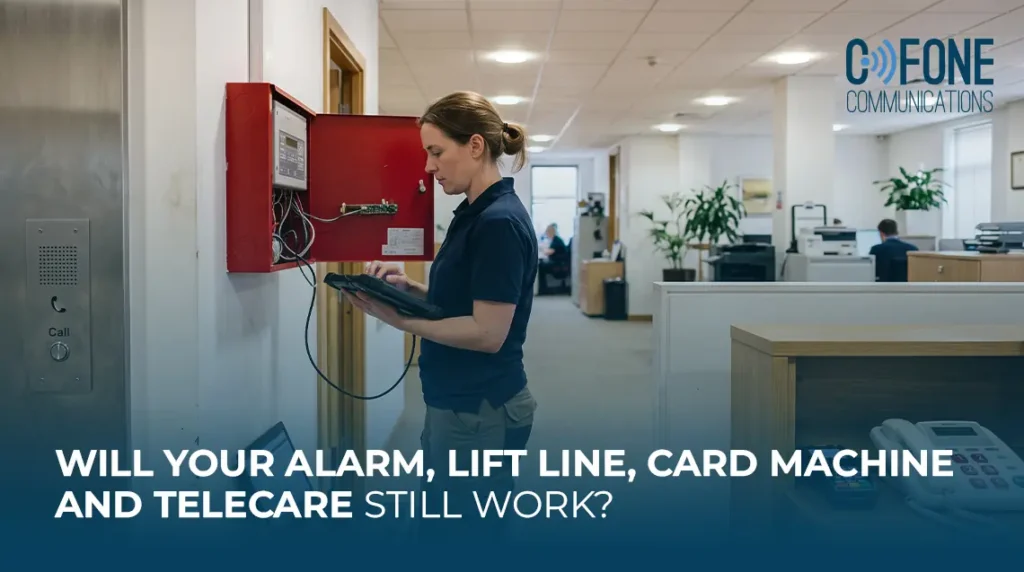
Moving to a digital landline sounds like a phone upgrade. For many businesses it is really an equipment audit. The burglar alarm that calls the monitoring centre, the emergency phone inside the lift, the card machine behind the counter and the telecare units in a care home were all built for the old copper network.
Openreach is switching that network off on 31 January 2027. Our PSTN switch-off guide covers the dates and costs. This article goes device by device: what breaks, how to fix it, roughly what it costs, and who to call.
CFone has been installing business phone systems since 1973, from analogue switchboards to cloud VoIP, so this guide is written from the installer’s side of the switchover.
What a digital landline is
A digital landline is a phone service that runs over your broadband connection using VoIP (Voice over Internet Protocol), rather than over a dedicated copper line. You may see it called a digital phone line, BT Digital Voice (BT’s consumer and business service), or simply an all-IP line.
The difference that matters for your equipment is simple. An analogue phone line carries a steady electrical signal and its own power from the exchange. A digital line carries data. Devices that “speak” analogue tones, such as alarm diallers, fax machines and older card terminals, need either an upgrade or an adapter to work on it.
What changes on the day you switch
- Your phone plugs into the router, or into an ATA adapter (analogue telephone adapter) that converts old handsets and devices to digital.
- The master socket stops carrying a live line. Extension sockets wired around the building may no longer work, and rewiring is often needed (MoneySavingExpert Forum).
- If the router loses power, calls stop, unless you have battery backup.
For businesses the replacement is usually a VoIP or cloud phone system rather than a single digital line. For a comparison of the two technologies, see VoIP vs landline.
Devices at risk on a digital landline
Openreach lists phone systems, card payment terminals, fire and burglar alarms, more than 12,000 lift lines, over 500 CCTV lines, smart meters and vending machines among the equipment that must be checked (Openreach). Walk your building, find every phone socket, and use this table as your audit.
| Device | What breaks | The fix | Rough cost | Who to call |
| Intruder or fire alarm with auto-dialler | Bell still sounds but alert calls or signals to the alarm receiving centre can fail | Dual-path IP/4G signalling unit | Around £500 quoted to one user* | Alarm installer / monitoring company |
| Red Care alarm line | BT Redcare closed 15 Dec 2025 | Replacement dual-path service (e.g. certified to BS EN 50136) | Supplier quote | Alarm installer; tell your insurer |
| Emergency lift phone | Autodialler cannot call out on a digital line | 4G GSM gateway or IP autodialler meeting BS EN 81-28 | From about £145 + VAT, plus SIM (about £75 + VAT a year)** | Lift maintenance contractor |
| Card machine (PDQ) | Dial-up transactions fail | Switch to broadband, Wi-Fi or 4G terminal | Often a terminal swap; check your contract | Card terminal provider |
| Franking machine | Rate and credit updates over the phone line fail | Connect by LAN or internet | Usually no hardware cost if network-ready | Franking supplier |
| Door entry / intercom | Calls to phones or mobiles stop | IP or 4G door entry module | Supplier quote | Security installer |
| Telecare and nurse call | Analogue alarm signals may not reach the response centre | Digital telecare units; end-to-end testing | Often covered by the telecare provider | Telecare provider and your landline provider |
| Fax machine | Unreliable over IP | Email-to-fax, or an ATA (analogue telephone adapter) with fax support | Low | Your phone provider |
| CCTV with dial-out alerts | Alerts stop | IP or 4G alerting | Supplier quote | Security installer |
If you manage several sites, add columns for location, supplier contract number and test date. That turns this table into your switchover log.
Alarm systems and Red Care lines
Alarms are easy to overlook, because the alarm itself keeps working. The siren still sounds. What fails is the auto-dialler, the part that tells the keyholder or the alarm receiving centre (ARC) that something has happened.

One MoneySavingExpert user summed it up: their burglar alarm would still ring, but the automatic alert calls would not be possible after the switch. Their alarm company quoted around £500 for a converter, and BT would not cover it (MoneySavingExpert Forum). That is a common pattern. The line provider moves the line; the alarm is your responsibility.
What happened to Red Care?
Red Care (BT Redcare) was a widely used signalling service for monitored intruder and fire alarms. It closed on 15 December 2025 because of the move to all-IP networks (CSL). If your alarm was on a red care alarm line and has not been upgraded, it may no longer be signalling at all. Check with your installer today, and tell your insurer, as many policies require monitored signalling.
What to replace it with
The standard answer is dual-path signalling: the alarm sends its signal over two routes, typically IP broadband and 4G, so one can fail without the alarm going silent. Look for units certified to BS EN 50136, the European standard for alarm transmission, and ask which grade your insurer requires.
Many businesses still pay for a separate phone line for alarm system signalling. After the switch, that line is not needed. A dual-path communicator on your broadband, with its own 4G path, does the job instead. Treat the alarm line digital switchover as a job for your alarm company, and book it before your phone line moves.
Emergency lift lines
Every passenger lift has an emergency lift phone so trapped passengers can call for help. Most were connected to a dedicated lift phone line on the copper network. Openreach counts more than 12,000 of these lines still to migrate (Openreach).
Lift remote alarms follow BS EN 81-28, the British and European standard for remote alarms on passenger lifts (BSI). Its 2022 update, in effect from 21 February 2025, tightened two things that matter for the switchover (Avire):
- Test calls: the automatic test call, made at least every three days, must use the same route as a real alarm call, including the full 4G voice path.
- Battery backup: where the autodialler and 4G gateway are one unit, both parts need monitored battery backup.
The usual fix is a 4G GSM gateway or an IP autodialler. Example units start from about £145 + VAT, with a data SIM at around £75 + VAT a year (Cloud Telecom Services). Always have your lift contractor fit and certify it, as the whole system, not just the box, must meet the standard.
Card payment terminals and franking
Card payment terminals (PDQ machines)
Older countertop PDQ machines dial out over a phone line to authorise each payment. On a digital landline those calls can fail, and a failed card payment is lost revenue. Most modern terminals can connect over broadband, Wi-Fi or 4G instead.

A shop owner on UK Business Forums moved their terminal from the phone line to broadband and found transactions faster, with only a few kilobytes used per payment. Forum members also advised keeping a backup route in case the broadband drops (UK Business Forums). A 4G-capable terminal gives you that fallback without a phone line.
Ask your terminal provider three questions: can this terminal run over IP, does it have 4G backup, and is the IP connection PCI DSS compliant.
Franking machines
Some franking machines still download postage credit and rate changes over an analogue line, and suppliers note they will not work on a digital or VoIP line (European Postal Systems). Most current models can connect by LAN or internet instead. Your IT provider may need to allow the machine through the firewall, so book it before switch day.
Hotels, pubs and restaurants usually have several card terminals, plus room phones and door entry to consider. Our business phone solutions for hospitality cover hotel and restaurant set-ups.
Telecare and care homes
Telecare is the part of the switchover with the most at stake. Around 2 million telecare devices are in use across the UK (thinkbroadband). Many older units, including pendant and fall alarms, send analogue tones that may not travel reliably over a digital line. Forum users report fall alarms that were not compatible after the switch (MoneySavingExpert Forum).

What the rules say
In February 2025, DSIT and the Department of Health and Social Care published the Telecare National Action Plan. Its first commitment is that no telecare user should be moved to a digital line until the communications provider, the customer or the telecare provider has confirmed a working, compatible solution is in place (thinkbroadband).
Age UK’s advice to anyone using an analogue personal alarm is to call their landline provider, which is responsible for keeping the alarm working through the switchover. Digital, GPS and smartwatch alarms are not affected (Age UK). The Local Government Association also publishes a digital switchover telecare checklist for councils and providers.
Care homes and nurse call
Care homes face the telecare digital switchover at scale: nurse call systems, door alarms, fire panels and resident phones may all touch the phone line. Ask your nurse-call supplier whether the system has been tested on all-IP, and whether it follows guidance from the Telecare Services Association (TSA), the industry body for technology-enabled care.
For practical set-ups, see our business phone solutions for care homes and business phone solutions for healthcare clinics. NHS sites can read about our phone system for NHS services, and dental practices our phone system for dental practice page. Schools with lifts, alarms and door entry should see phone systems for schools.
Power cuts and battery backup
A copper line was powered from the exchange, so a corded phone kept working in a power cut. A digital landline is powered by your router. When the power goes, so does the line, unless you plan for it. Users on MoneySavingExpert also point out that the backup units offered to households last about an hour, and that anyone with weak mobile signal could be cut off (MoneySavingExpert Forum).
Ofcom expects providers to offer customers who depend on their landline a way to call 999 for at least one hour in a power cut (Ofcom). Providers signed up to the government’s PSTN charter have committed to develop backup that goes beyond that minimum (thinkbroadband). For a business, plan your own resilience:
| Measure | What it protects | Notes |
| UPS (uninterruptible power supply) | Router, switch and key desk phones | Size it for the runtime you need, not just one hour |
| 4G failover router | Calls and card payments if broadband fails | Needs good mobile signal; check before you rely on it |
| Battery backup in alarm and lift units | Safety signalling during outages | Required for lift units under BS EN 81-28 |
| Automatic call diversion | Your main number, diverted to mobiles | Set up in your phone system in advance |
Write these into your business continuity plan so staff know what still works in an outage, and register your correct address with your provider so 999 calls show the right location.
How to test devices before you switch
Compatibility testing is the step that prevents nasty surprises. Openreach offers free all-IP compatibility testing at its labs, so ask each supplier whether their equipment has been tested (Openreach). Then test on your own site:
- Build your list. Use the audit table above. Photograph each device and its model label.
- Ask each supplier in writing. “Is this model all-IP compatible? If not, what do you recommend, what does it cost, and how long is the lead time?”
- Book upgrades before the line moves. Alarm and lift upgrades should be done first, not after.
- Keep the old line live until testing is complete. Do not cease it early.
- Test each device on the new line. Send a test alarm signal to the alarm receiving centre, make a lift test call, run a card test transaction, send a franking update and trigger each telecare unit end to end.
- Test a power cut. Switch the router off at the wall and confirm the UPS, 4G failover and battery units behave as expected.
- Record the results. Date, device, result and who tested it. Insurers and lift inspectors may ask.
Digital landline FAQs
Will my burglar alarm work on a digital landline?
The alarm will still sound, but a monitored or auto-dial alarm may stop sending alerts. Most need a new communicator or a dual-path IP/4G unit. Ask your alarm company to confirm and upgrade it before your phone line moves.
What happens to lift emergency phones?
Lift phones need an IP or 4G-capable autodialler to work on a digital line, and many lift lines are still analogue. Under BS EN 81-28:2022, test calls must use the same route as real alarm calls, so have your lift contractor fit and certify the upgrade.
Does a digital landline work in a power cut?
Not on its own. A digital landline is powered by your router, so it stops when the power does. Battery backup such as a UPS, plus 4G failover, keeps calls running. Ofcom expects at least one hour of emergency access for customers who depend on their landline.
Can I keep using my card payment terminal?
Most modern card terminals can run over broadband, Wi-Fi or 4G. Older dial-up PDQ machines usually need replacing. Check with your terminal provider and ask for 4G backup so payments continue if the broadband drops.
Who pays for alarm and telecare upgrades?
Usually the business or its alarm or telecare provider, not the line provider. For individual telecare users, the landline provider should confirm a working solution before migrating them. Get quotes early, as lead times grow near the deadline.
How do I find out which devices use my phone line?
Walk the premises and list every device plugged into a phone socket, including alarms, lifts, card machines, franking machines, door entry and fax. Then ask each supplier in writing whether it is all-IP ready.
Getting your devices ready with CFone
Moving to business phone systems that run on broadband is only safe once everything else on the line is sorted. We plan the phone switch around your alarm, lift and payment suppliers, so nothing is left without a working connection.
- Engineering-led since 1973, through analogue, ISDN and cloud VoIP.
- Crown Commercial Service supplier: see our Crown Commercial Service accreditation.
- Rated 5.0 on Google, with 24/7 support from a UK team based in Hillingdon, Middlesex.
- Resilience built in: see our phone system features, including call diversion and mobile apps.
If you are unsure what is plugged into your lines, contact our team and we will talk through your audit with you.